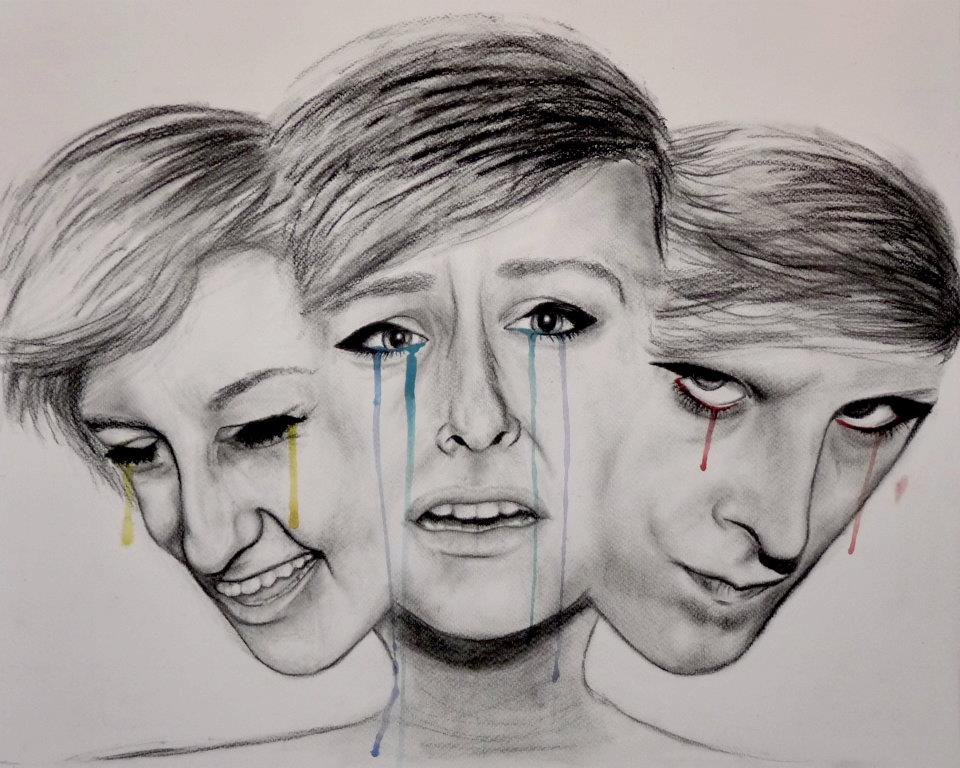
Okay.
Let me ask you, have you ever heard about one of the rare disease - Dissociative Identity Disorder?
If yes, how deep is your knowledge about this disease?
And if no, let’s
together with me discover the exact disease named Dissociative Identity
Disorder.
At first,
Dissociative Identity Disorder (DID) is known as Multiple Personality Disorder
until 1994. Why the name changed? Sit back and wait. I’ll explain it later.
DID is a
condition which an individual has two or more distinct identities or
personality states. These different personalities, called as alters, alternately
take control of the patient and what awful is the patient will experience
memory loss that's totally different to ordinary forgetfulness. That is why the
patient cannot be able to maintain a clear sense of memory or self during the switches.
Sometimes,
we forget to bring our book or forget to do what we should do. But hey, do not
worry, these have no relation with DID.

The name
changed after 1994 after the psychiatrist discovered that this disorder is
actually a fragmentation or splintering of identity rather than growth or
procreation of separate identities.“Some people do have what scientists now
call “dissociative identity disorder” (DID), a name change made official in
1994, when the American Psychiatric Association published the fourth edition of
its Diagnostic and Statistical Manual of Mental Disorders.” (The Dana
Foundation, 2008, as cited in David Spiegel, 2006)
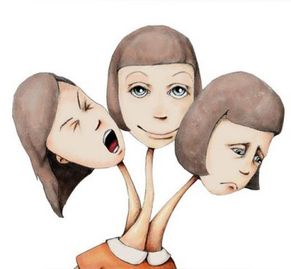
For your information, the patient of
DID is like an actor that act in different drama with different personalities.
In this drama or movie, he might be a villain, but the other drama he might be a
saint. Or simply explained by Kirstin Fawcett, 2015 “One minute, someone with
DID is saying something; the next, another element of his identity emerges and
he brings up a new topic midstream.” This also explained well that the alter
causes patient have a different names
According
to Sue-Mei Slogar’s (2011, as cited in Rubin & Zorumski, 2005) this
disorder estimated prevalence of DID ranges from 1 to 5%, while females mostly
the victim of DID at a ratio of 9:1 (as cited in Lewis-Hall, 2002). Based on
these
Why?
This is because according to what has been reported by
Robert J. Waldinger in his own book (p. 213) that the patient and the alters
may or may not aware her or his own condition that have several personalities.
In fact, National Alliance on Mental Illness (NAMI) revealed, “A person living
with DID may have as few as two alters or as many as 100. The average number is
about 10.”
Isn’t that quite amazing yet awful?
 |
| Children are gift of God |
Every little child was born not to be neglected. They are the precious gift of God to make the world more merrier with their innocent laugh and talks. However, they are some parents or people out there being a monster who always neglects the children as if the children are toys.
What is neglects and what is the relation between the disorder?
According to American Human is defined refer
It does not matter what kind of neglect that you have done with the kids. If their behavior goes wrong like being depressed or become silent, then there is must be something. However, mostly DID is caused by trauma of physical abuse and emotional abuse.

That is
why, when they being assaulted or had very serious injury, the victim seems
dazed and unaware their condition either bad
This can be proved by
Goldberg, J, 2014, “As many as 99% of individuals who develop dissociative
disorders have recognized personal histories of recurring, overpowering, and
often life-threatening disturbances at a sensitive developmental stage of
childhood (usually before age 9). Dissociation may also happen when there has
been insistent neglect or emotional abuse, even when there has been no overt
physical or sexual abuse.”

At the end, we now realize, that child
abuse either physically or sexually can lead them into being Dissociative
Identity Disorder patient. We might think that they will recover anytime either mentally or physically. But, who knows actually, they are more hurt inside and they don't have someone
Now, let’s
Since the
DID patient had a very heart-breaking
Below are
the list of further symptoms that the victim tends to have in experiencing
separate identities:
- Confusion
- They might have confusion when they realize that what not belong to them was theirs or maybe some strangers suddenly acknowledge them.
- Phobia
- They may have a phobia towards some places that they being abused, or some people that abused them.
- Selective of loss memory
- They don't remember for certain time period, events including recognizing their cliques
- Personality change
- They might immediately change into different personality like shy, aggressive, straightforward or daring. They also tend to change gender either become woman or man
- Anxiety/Panic attacks
- Headaches
- Flashbacks
Don't worry. We got some treatments to treat the patient.
At first, the patient will go through psychotherapy with
hypnosis. At alters have breakdown
 |
| Taken from http://www.samahospital.com/blog/wp-content/uploads/2015/08/psychotherapy.png |
Why
therapist want to find alter
This is
because, the memories of trauma are really important for a person who live with
DID. It is a must for a therapist to help the patient to retrieving and dealing
with the trauma so that they can face the reality and recover the pain that
they had.

Next, some psychotherapists are using anxiolytics and antidepressants which are the drugs. Below
these group carbamazepine prazosin specialist naltrexone proved amnestic
However,
DID patient need the therapist in order to help themselves regain their own
body from being controlled by other alters. The usage of drug without any help
from therapist are hopeless.

What we can
do is now, do not ignore or isolate people who have Dissociative Identity
Disorder. The family member and friend of the patient can show the support in many
ways like:
- Be informed
- Learn about DID as more as you can. Did some research
- Find a therapist
- You may search some information about
therapist - Be universal
- During the switches, sometimes the patient has no idea about you. What you can do is introduce yourself and offer reassurance if they are frightened. Become friends to the other personalities.
- Be aware
- Sometimes, they tend to suicide. Be alert and make a call for help.
- Listen
- Willing
to
listen wants solution

No comments:
Post a Comment