WARNING: The picture provided may discomfort.
You will give a birth soon!
What if, your baby turns out like this?

Have you ever imagined your baby had this kind of disease?
What would you do?
Your baby..
***
Before I go further about the disease, I would like to apologize because I posted
Okay, let's begin.
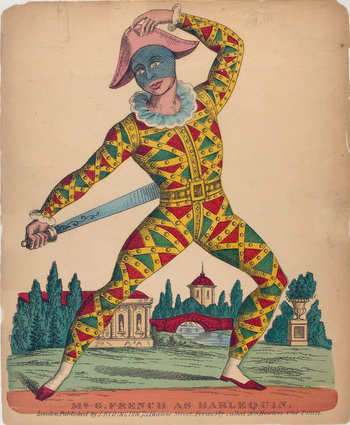
The name of the disease is Harlequin Ichthyosis. The idea of the name is originally from how the condition of the skin which armour suit jester

Not only that, the baby also had a really bad
face’s condition where the face looks stretched with turned out lips, eyelids
and the worst is the ears, hands and feet may hidden limit especially at eyes
According to some research, "There are approximately five such children born in the UK each year and some may be stillborn."(Ichthyosis Support Group, 2013). We can conclude that the disease is extremely very rare.
Back to 1750, April 5, the history of the disease begin when Reverend Oliver Hart, a cleric from Cherleston
 |
| Taken from http://archpedi.jamanetwork.com/article.aspx?articleid=1175910 |
The excerpt was written like this:
"I went to see a most deplorable object of a child, born the night before of one Mary Evans in ‘Chas’town. It was surprising to all who beheld it, and I scarcely know how to describe it. The skin was dry and hard and seemed to be cracked in many places, somewhat resembling the scales of a fish. The mouth was large and round and open. It had no external, but two holes where the nose should have been. The eyes appeared to be lumps of coagulated blood, turned out, about the bigness of a plum, ghastly to behold. It had no external ears, but holes where the ears should be. The hands and feet appeared to be swollen, were cramped up and felt quite hard. The back part of the head was much nose . It made a strange kind of noise, very low, which I cannot describe. It lived about eight and forty hours, and was alive when I saw it." (Waring, 1932) open
Unfortunately, the baby died 48 hours later.
The excerpt written by Reverend described well about the disease. In fact, the baby who had this kind of the disease has a very short lifespan due to limited movement of the chest.
Actually, this disease also can be considered as a genetic disease due to a single important skin gene was mutated. The mutation is in ABCA12, a gene that involved in transportation of lipids (fats) into the spaces between the
cells in the skin's uppermost layer and provides instructions for making a ABCA12 protein that is essential for the normal development of skin cells.
 |
| The picture above shows that the lipid was transported into the LG and ABCA12-positive LGs fuse with the cell membrane to secrete lipid into extracellular space to form the intercellular lipid layer. Taken from http://flipper.diff.org/app/items/info/3254 |
We all have experienced in learning Biology. If you still remember, these lipids provide a benefit as a defend walls against bacteria and infection.
However, based on Genetic Home Research, 2015, due to mutation, Harlequin Ichthyosis can form since itleads functional
However, based on Genetic Home Research, 2015, due to mutation, Harlequin Ichthyosis can form since it
 |
| Taken from http://amaprod.silverchaircdn.com/data/Journals/DERM/4695/dre50009f2.png |
Not only that, this
disease can be inherited. It will show if an individual receives carrier ichthyosis
Thus, as precautions, for those who have a Harlequin history partner or parents-to-be,
it would be better if you aware and learn this disease. It is not too late to
learn. In fact, it may help you in future, especially to
As I said before, those who are known as carriers of the disease won’t show any symptoms of disease but not for the next generations that inherit the disease.
This is
because, first, obviously, the disease cannot be prevented since it happens in
skin gene
But, do not
give up!
Even it cannot be prevented, but there is a possible way to know either the baby is affected or not.
Even it cannot be prevented, but there is a possible way to know either the baby is affected or not.
According to Ichthyosis Support Group (ISG), 2013 “It is possible to diagnose or recognize it early in pregnancy by removing some of the amniotic fluid surrounding the developing fetus to identify if there is a mutation in ABCA12.”
 |
| The picture above shows the amniotic fluid removal |
Or the
parents can check at any medical center provides
 |
| Taken from http://www.obgyn.net/sites/default/files/resize/obgyn/2149236-400x271.png |
 |
| Taken from http://www.ultrasound-images.com/admin/uploads/icthyosis-tongue-2c.jpg.jpg |
How to
identify the affected baby?
According
to some researchers, both parent and doctor may detect it if the fetus
- Small flexed digits of the hands and feet
- Toes
hyperflexed
This video proves that the baby has small flexed digits of hands feets hyperflexed
If the
finding is positive, it will become a great chance for parents to continue or
terminate the pregnancy. But, if possible, keep the pregnancy and try several methods to survive the baby. Right?
What
Back to the past, we do not have any specific treatments and
Fortunately, today we are born with technologies surrounding which is make
 |
| It has been reported about a baby in Malawi died because of infections and lack of medical technologies due to Harlequin Ichthyosis on 2013 |
Recent advances are such relief for parents who
decided to continue the pregnancy and give born the baby. One of the advance
is the existence of neonatal care with administration of etretinate
| The neonatal intensive-care unit (NICU) |
For your information, neonatal care or known as neonatal
intensive-care unit (NICU) is an intensive care unit that is specialized in the
care of ill or premature babies. In the NICU, the babies will receive special
treatment with the administration of etretinate
Not only that, the
babies also will receive a treatment in incubator is maintained and prevent skin cracks. In addition, since the baby was exposed to the infections, the antibiotic also may be
prescribed to prevent infection.
The
treatment does not only covered the early stage of the baby development. The
treatment will continue until the baby become
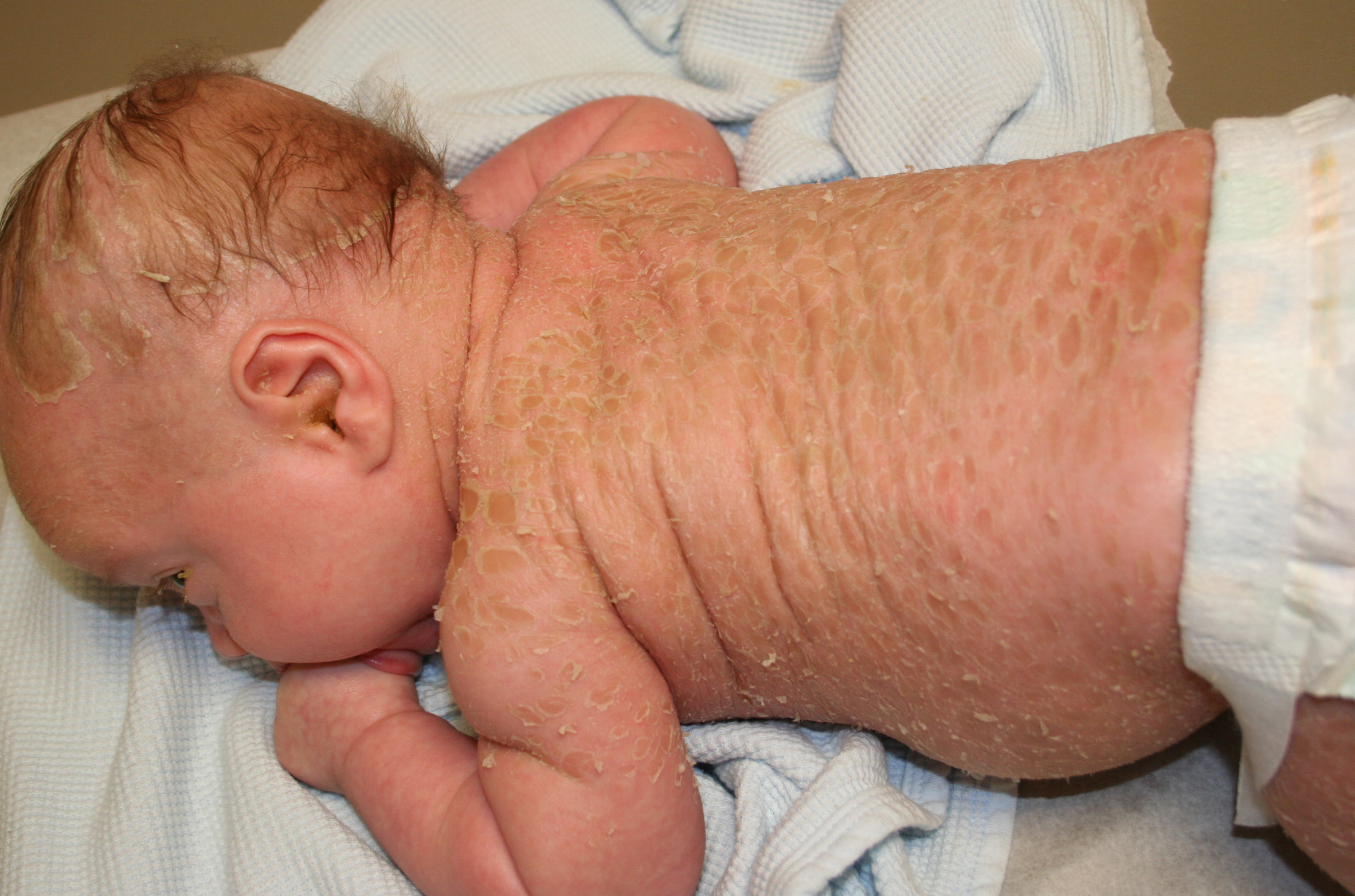 |
| The skin is starting |
Don't worry, with
treatment provided, the thick plate-like skin gradually splits and peels off. Not
to forget, harlequin ichthyosis requires a daily skin care routine to keep the
skin supple and moisturise
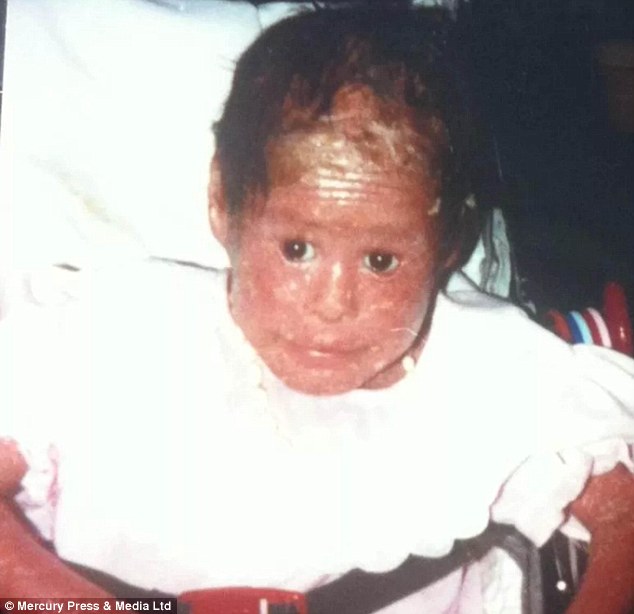 |
| The skin is reddened and the hair is sparse |
Be alert that during
the teenage years or twenties, most of surviving
So, keep the worries away!
So, keep the worries away!
Now, we have reached the conclusion. Be a mom is absolutely every womens' moment if the baby was not what the parents expected-healthy and pretty. As a human being, what else we can do except receive the little angel with a big heart without any hard feeling.
As parents, it would be good if both of you give courage and support them to have a good live. Show them a very big love without any comparison. Have faith in them, that they are the most precious child in the world.
For sure, there are families with one or more children with Harlequin Icthyosis who live happy and relatively normal lives. Remember, every cloud has a silver lining.
Don't worry, you are not alone.
Smile.


No comments:
Post a Comment