Another
rare disease we
Try guess
First, the case is reported around 8 in 1 million
births. Second, this disease has
five types. And the last hint is the
babies are either stillborn or die within the first 3 days of life.
So, do you
have any idea about the disease?
By the way,
the hints given are bit disease s
Back to the
track, what is the answer?
Allow me to
reveal the answer.
The answer
is Ectopia Cordis.
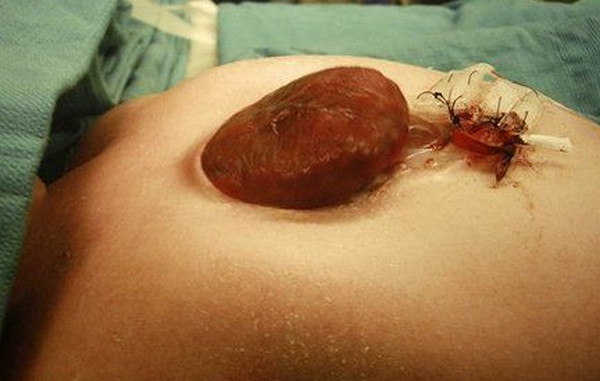 |
| This is how Ectopia Cordis looks alike |
We all
informed that, the heart is located in the center of the chest cavity where it
resides in the space between the lungs (inferior mediastinum

But, not for Ectopia Cordis.
What is
Ectopia Cordis?
According
to Kanagasuntheram, R (as cited in Willius … some of researchers heart
For your
information, the name given is an idea from Greek word which means means
In 1997,
the disease has been classified into 5 types which is consider
- Thoracic Ectopia Cordis
- Abdominal Ectopia Cordis
- Thoraco-abdominal Ectopia Cordis
- Cervical Ectopia Cordis
-
Cervicothoracic
However,
thoracic type is a common case and it was 65% cases reported while cervical
type
Before we
go deeper, have you ever wonder, what the cause of this disease?
There are
several theories how ectopia cordis week
Parents who
want to make sure the baby is affected or not, actually it is not hard to
detect if the baby have ectopia cordis centre at
 |
| Taken from http://sonoworld.com/images/FetusItemImages/images2007/Cardiac/Pentalog_Cantrel_Sanchez201207/1.jpg |
For your
information, the heart is actually underdeveloped and the ectopic heart is
totally not protected by the skin or sternum. Thus, many other heart defects
are associated with this condition. That is why most babies that are born alive
will die after their first few days. Only several lucky babies will survive.
Now, let's focus on the
treatments.
The parents
have only two choices. Either to continue or abort the pregnancy. However, All
Health Site, (2013) mentioned that most parents always consider terminating
the pregnancy. But, some of them still want to continue the pregnancy. Thus,
non-aggressive during deliver is recommended due to the disease.
Don’t
worry. Even though the treatment for baby is limited, there are still successful
surgical recorded. The surgical is of course to repair the intracardiac
 |
| Audrina Cardenes, ectopia |
As for support,
both mother and father have to be strong facing any kind disease that the
children had. In this case of disease, the parents need to be wise in making
decision. If the parents decided to continue the baby, believe that there is
still hope that the baby will safe
Now, we are
surrounded by technology. Aren’t that was a good news? Based on Kabbani et al.
(2002), with the advances in all aspects of medicine, the number of infants who
undergo successful surgical repair and survive is steadily increasing.
So, don’t worry. Believe me, every problem sure has the key to solve it!
So, don’t worry. Believe me, every problem sure has the key to solve it!

No comments:
Post a Comment